Funeral Photo Display Ideas: 12 Gentle Ways to Share a Life in Pictures
A funeral photo display works best when it tells a life in chapters rather than all at once: a memory board or two near the entrance, a memory table with photos beside the things they loved, a slideshow during the gathering, and a memory wall where family and friends who couldn't travel add their own photos and words. Below are 12 ideas, from the simplest printed board to on-screen tributes, with what each one needs.
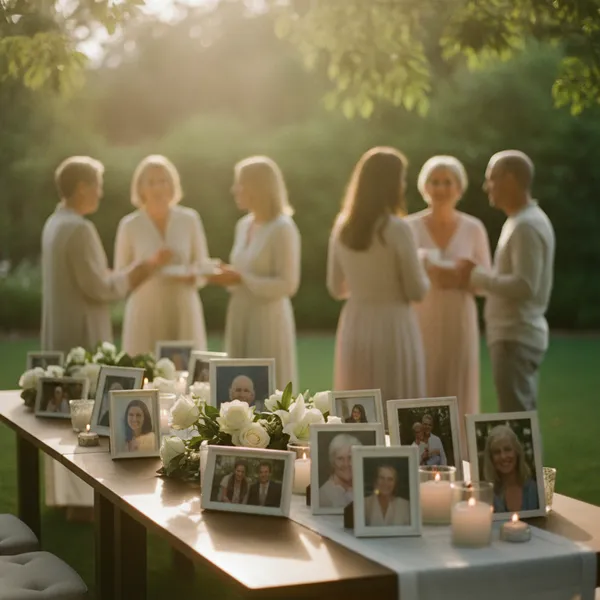
Printed displays
Printed photos invite people to stand close and talk. They also give the room somewhere to gather when conversation is hard.
1. Memory boards by chapter
Instead of one crowded board, make two or three, each a chapter: growing up, work and friendship, family. Put a small label at the top of each. People find the chapter they shared and stay there — which is where the stories start.
2. The clothesline or ribbon board
Twine and small wooden clips on a trifold board or a frame hold photos without tape or glue, so nothing is damaged and prints can go home with family afterwards.
3. A life timeline along a wall or table
Lay photos out in order, with the year and a few words beside each: "1968, the first house", "1994, Grandma's 50th". A timeline helps younger relatives see the whole person, not only the one they knew.
4. Framed favourites on easels
Three or four large framed photos — one portrait, one with family, one doing the thing they loved — on easels near the entrance. Fewer and larger reads as calm.
Memory tables and keepsakes
5. A memory table
Place photos next to objects that were theirs: reading glasses on a favourite book, garden gloves, a recipe card in their handwriting, a medal, a fishing reel. The objects do something photos can't — people pick them up, and remember.
6. A memory jar or card box
Put out blank cards and a jar or box with a simple prompt: "A memory of Mum", "Something he taught me". They become something the family keeps. Keep a pen on the table and a few cards already filled in so nobody has to go first.
7. A table for the things they made
If they knitted, painted, built or baked, display a few of the things they made beside photos of them making them. It's a portrait no photograph manages alone.
On a screen
8. A quiet slideshow during the gathering
A looping slideshow on a TV where people naturally stand — by the coffee, near the entrance — lets many more photos be shared than any board can hold. Keep each photo up for five to eight seconds and the music low or off, so it accompanies conversation rather than replacing it.
9. A live memory wall
A memory wall is a screen at the service that family and friends add to from their phones: they scan the QR code on the screen, choose a photo from their camera roll or write a few words, and it appears in about a second. Relatives who can't travel post through the same link from wherever they are, and their photos appear in the room with everyone else's. In our own data, memorial walls collected more posts than any other occasion — a median of 179 posts among walls with at least 10. People arrive with decades of photos already on their phones. (How to set one up, step by step: setting up a funeral photo wall.)
10. Recorded words from far away
Ask relatives who can't attend for a short written memory, then read a few aloud or show them on the screen. It lets the people furthest away still be part of the room.
Afterwards
11. A gallery for everyone who came
Share the photos gathered at the service with the family afterwards, so the pictures people brought don't disappear back into separate phones. On a live memory wall's paid plans, everything shared can be downloaded and kept; the free plan shows five posts on screen at a time, rotating.
12. A memory book made from the day
Print the best of the boards, the cards from the memory jar and the photos people shared into a single book for the closest family. It's the display that lasts longest.
A gentle place to start
If the week is overwhelming, three things are enough: one memory board, a small memory table, and a way for people to share their own photos. Ask a cousin or a friend to gather the prints and bring the easels — people want a way to help. If you'd like the room to see photos from relatives who can't come, a live memory wall works on any screen at the venue; the family can review every post before it appears with the approval queue on Professional ($19.99/month).
Frequently asked questions
How many photos should be displayed at a funeral?
There's no right number. A memory board usually holds 20–40 photos; two or three boards around the room are common. A slideshow can hold far more — 100–200 photos at five to eight seconds each fills a gathering of an hour or two without repeating too often. Choose photos that show relationships and ordinary days, not only milestones.
How do you display photos at a funeral without damaging them?
Use copies, not originals: scan or photograph the originals and print copies for the boards. If originals must be shown, use photo corners or clips on a board rather than tape or glue, and keep them out of direct sunlight. Ask one family member to collect and return the originals at the end.
What goes on a memory table at a funeral?
A few framed photos from different parts of their life, placed next to things that were theirs or that they loved: reading glasses and a favourite book, garden tools, a recipe card in their handwriting, medals, a fishing reel, concert tickets. A guest book or a jar of blank cards for written memories often sits at one end.
How can family members who can't attend share photos for a funeral?
Collect them before and during the service with a shared link. A live memory wall lets relatives post photos and messages from anywhere through the same link guests in the room use by scanning a QR code on the screen; what they share appears on the screen at the service. In our own data, memorial walls with at least 10 posts collected a median of 179 posts, more than any other kind of event.
Should there be a slideshow at a funeral?
A slideshow suits the gathering before or after the service more than the service itself. Let it loop quietly on a screen where people naturally stand, with each photo shown long enough to recognise faces — five to eight seconds. Keep music low or leave it off so people can talk.
Ready to Transform Your Events?
Create engaging, interactive experiences that your attendees will remember. Join thousands of event organizers using QR Wall for conferences, corporate events, and more.
Get Started Free